
This barrier-free classic houseboat has the kind of quiet confidence I always admire in a home: practical at its core, but beautifully resolved in every surface and sightline. Set against the reflective calm of the water, it balances traditional marine character with a softer, more residential warmth, using pale timber, brushed metals, and a layered palette of ivory, sand, slate, and misty blue. I’m especially drawn to how the design turns accessibility into an aesthetic strength rather than a compromise, with broad passages, flush thresholds, and thoughtful proportions that make the whole home feel gracious and easy.
As a concept design, it imagines what barrier-free living can look like when it is given real elegance. The houseboat feels bright, grounded, and highly livable, with rooms that flow naturally into one another and details that make daily routines simpler without ever looking clinical. To my eye, that is what makes it special: it preserves the romance of a classic houseboat while giving it the ease, order, and comfort of a truly well-planned modern home.
Exterior
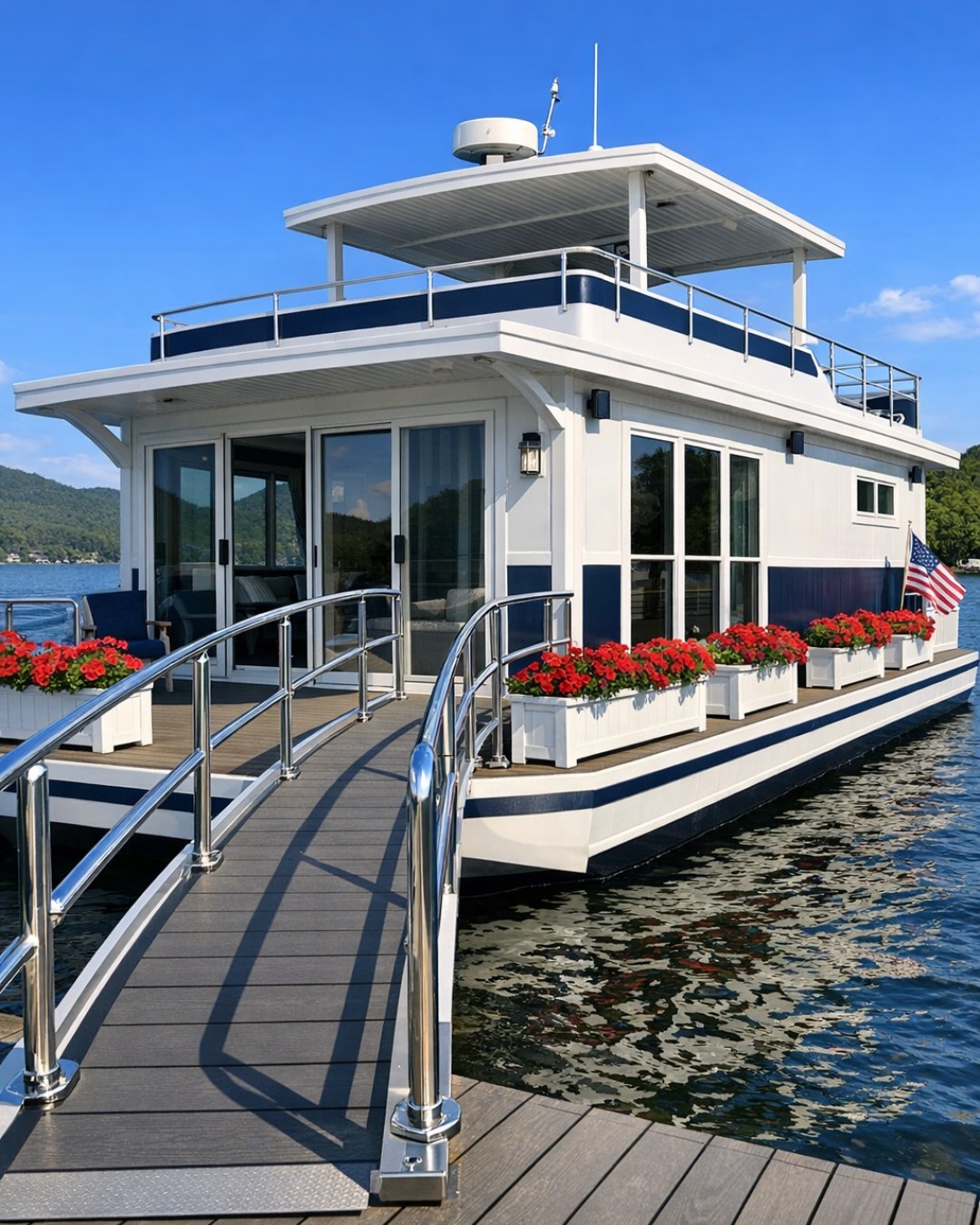
From the outside, the houseboat presents a refined, low-slung profile that feels timeless rather than trendy. The cladding appears to be painted wood in a soft warm white, trimmed with muted charcoal and weathered teak that brings in just enough contrast. Wide perimeter decking wraps the structure with the kind of generosity I always appreciate, especially in a compact footprint, because it immediately extends daily living outdoors. Railings are slim and sturdy, likely powder-coated aluminum, and the entry sequence is handled with unusual grace: a broad, gently sloped boarding approach that reads as part of the architecture instead of an afterthought.
What keeps the exterior from feeling purely utilitarian is its disciplined restraint. Windows are large and carefully aligned, framing long views of sky and water while helping the façade feel balanced and calm. I can imagine the exterior materials aging beautifully in a marine environment, with teak underfoot turning silvery over time and metal finishes holding a soft satin sheen. Even before stepping inside, the design signals comfort, safety, and permanence—three qualities I think any successful houseboat needs in abundance.
Living Room
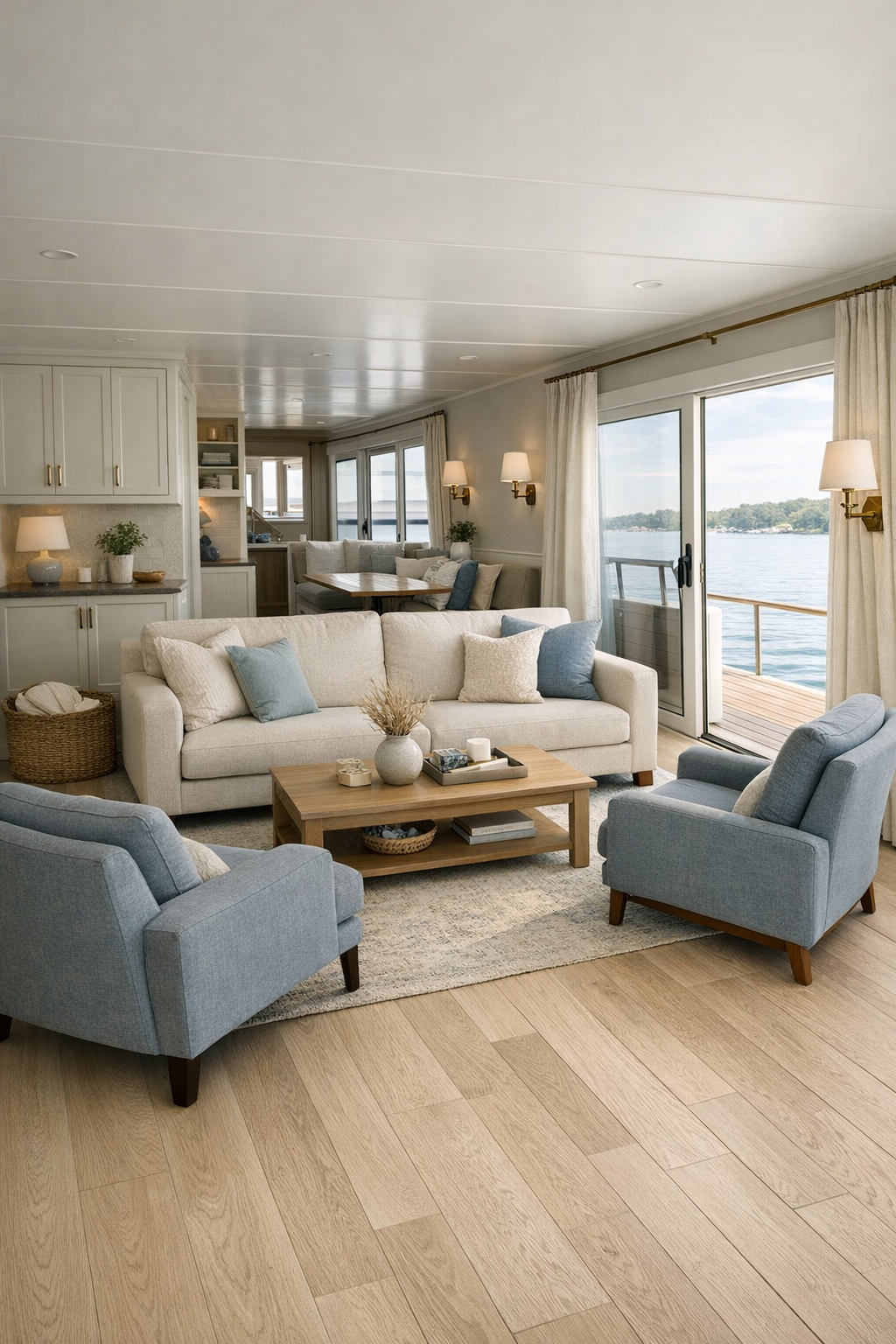
The living room is where the houseboat’s barrier-free planning becomes most visually persuasive. Circulation is broad and uninterrupted, with furniture arranged to preserve easy movement without sacrificing intimacy. A low-profile sofa in a textured oatmeal fabric anchors the space, paired with rounded lounge chairs in muted blue-gray and a generously scaled ottoman that can act as coffee table, footrest, or extra seating. I like the way the room avoids sharp visual clutter; corners are softened, tables have eased edges, and built-in cabinetry keeps essentials tucked away while maintaining a streamlined look.
Materially, the room feels light but not washed out. White oak floors run continuously through the main level, their matte finish giving the whole interior a gentle, natural warmth. Linen drapery filters the daylight instead of blocking it, and layered lighting—recessed ceiling fixtures, slim brass sconces, and a shaded floor lamp—makes the room usable from morning coffee to late evening reading. The water outside becomes part of the composition, reflected in glass and echoed in the palette, so the room has that rare sense of stillness I associate with the best waterfront interiors.
Dining Room
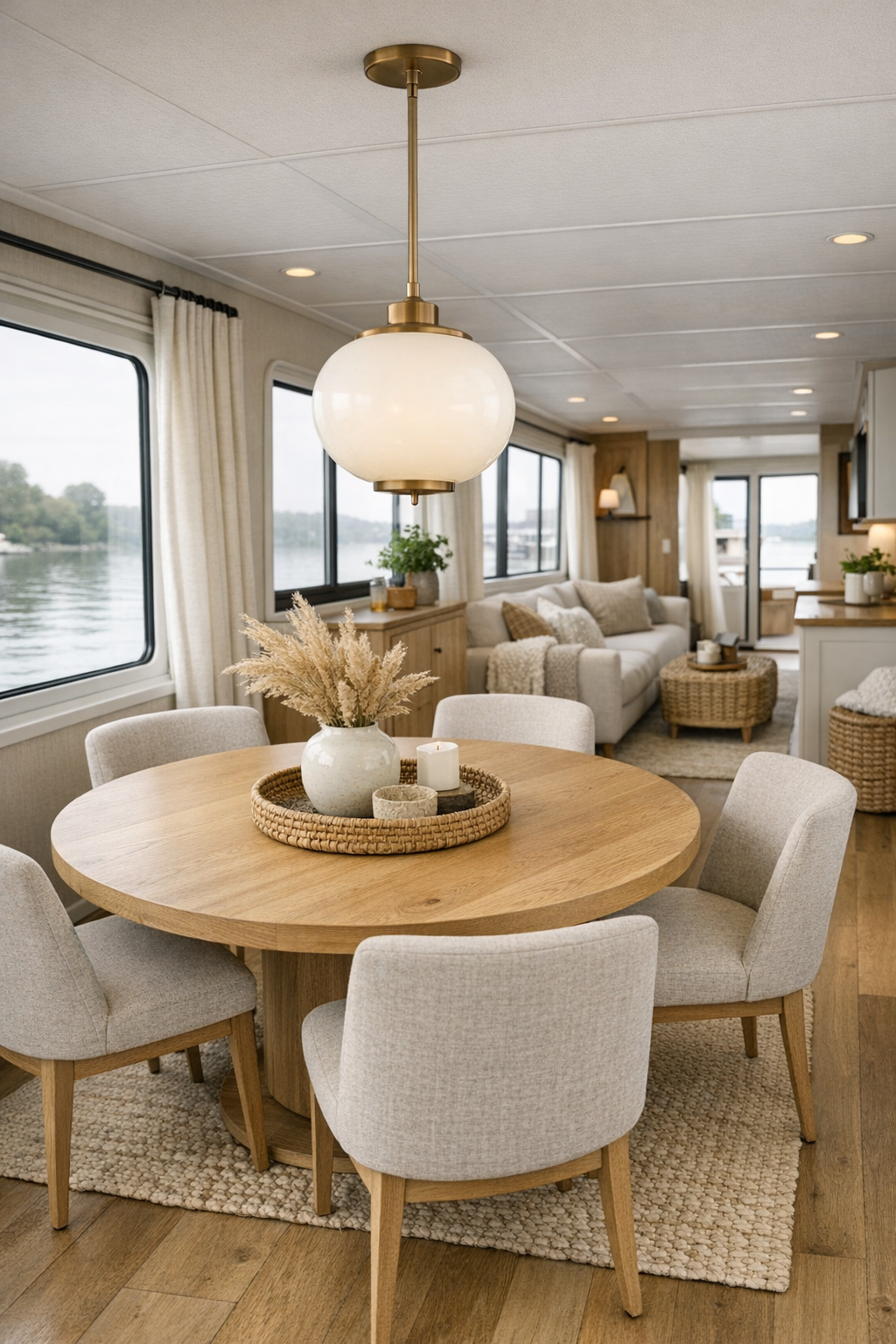
The dining area is compact, but it never feels squeezed. Instead of forcing a formal room where one does not quite fit, the design treats dining as part of an open social sequence, with enough clearance around the table to move comfortably from kitchen to living room and back again. The table itself is likely a round or softly oval piece in light oak, which I think is a smart choice here; it keeps traffic flowing and eliminates hard corners in a tight footprint. Dining chairs with upholstered seats and supportive backs add comfort, and their simple, tailored lines keep the room feeling airy.
Overhead, I imagine a suspended fixture in opal glass or a shaded brass pendant, scaled carefully so it centers the table without dropping too low into the visual field. The finishes continue the home’s understated language: pale timber, warm whites, woven textures, and perhaps a flatweave rug in a subtle stripe to define the area. If I were setting this table, I would not need much to make it shine—just stoneware, a bowl of citrus, maybe a simple vase—because the room already has what every good dining space needs: clarity, comfort, and an easy connection to the rest of the home.
Kitchen
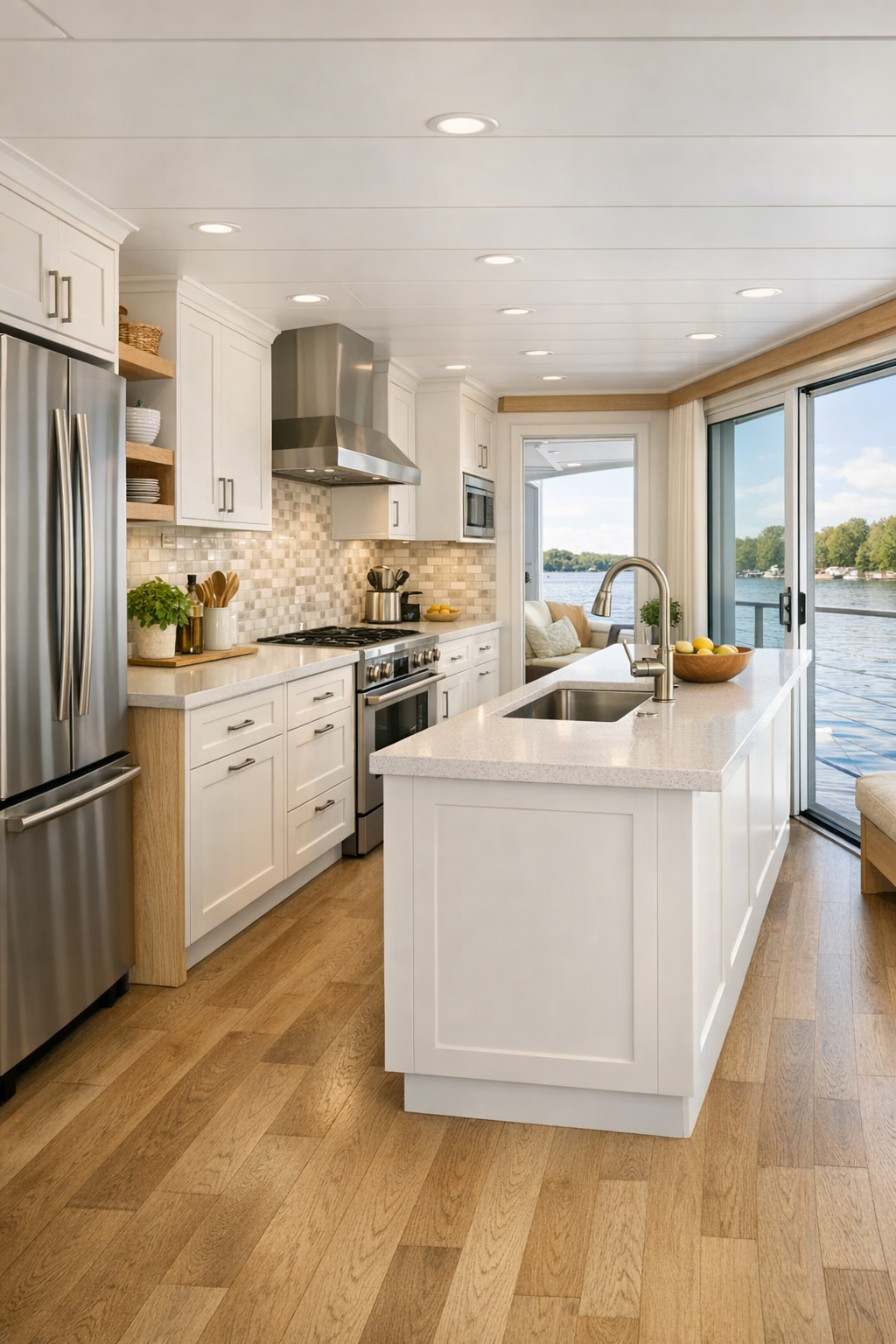
As someone who spends a great deal of time thinking about how kitchens actually work, this is the room I studied most closely in my mind. The layout appears beautifully disciplined: a galley or single-wall-plus-island arrangement with generous turning space, varied counter heights, and hardware that is easy to grip. Cabinetry in painted warm white or pale mushroom keeps the room bright, while white oak accents tie it back to the living spaces. I would expect durable quartz countertops in a soft honed finish, a full-height backsplash in handmade-look tile, and appliances integrated as seamlessly as possible so the room reads as furniture rather than machinery.
What makes the kitchen especially compelling is how it seems designed for real cooking, not just display. Deep drawers, reachable storage, layered task lighting, and open work surfaces all suggest a cook’s kitchen, one where prep, simmering, and cleanup can happen without awkward movement. A pull-down faucet in brushed nickel, induction cooking, and a slightly lowered work section would all make sense here. The result is polished but not precious, and that balance is hard to achieve. I can easily picture making a big pot of soup here, with daylight coming in off the water and everything I need right at hand.
Bedroom
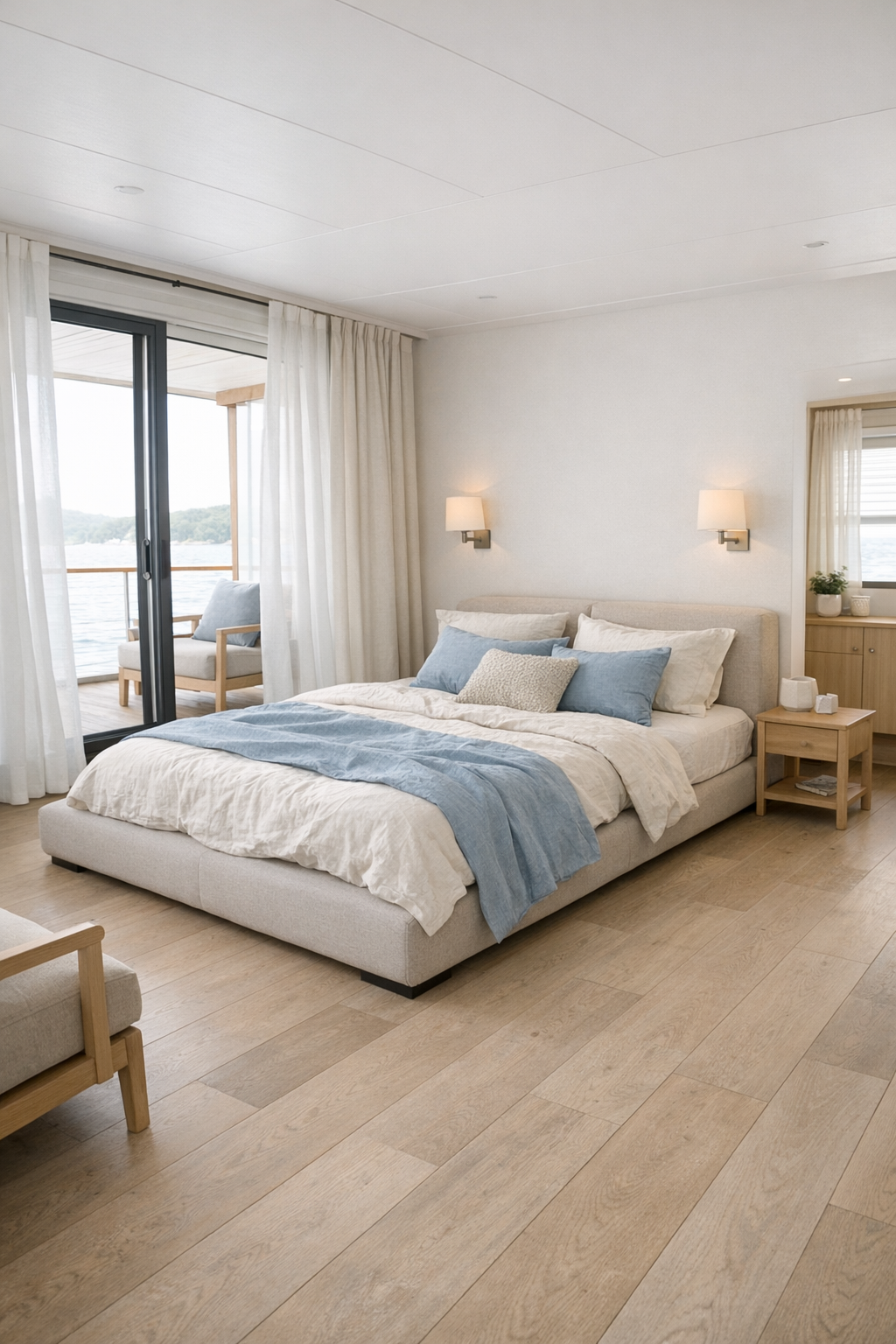
The bedroom takes a quieter, more cocooning turn while staying faithful to the home’s airy character. A low bed with an upholstered headboard in flax or soft gray keeps the visual weight down, which is especially important in a room where openness matters as much as comfort. There is ample clearance around the bed, and I imagine integrated nightstands or wall-mounted shelving that preserves floor space while keeping essentials within easy reach. The palette stays restrained—cream, driftwood, muted blue, perhaps a touch of charcoal in the lighting or hardware—so the room encourages rest from the moment you enter.
Texture does much of the work here. Crisp cotton bedding, a quilted coverlet, wool or boucle accent pillows, and a finely woven rug soften the architecture without cluttering it. Window treatments likely prioritize both privacy and light control, perhaps with layered shades and linen panels. What I appreciate most is the bedroom’s sense of dignity: accessibility is embedded in the proportions and joinery, not announced. It feels like a true retreat, one that understands how deeply comfort depends on ease of movement and calm visual order.
Bathroom
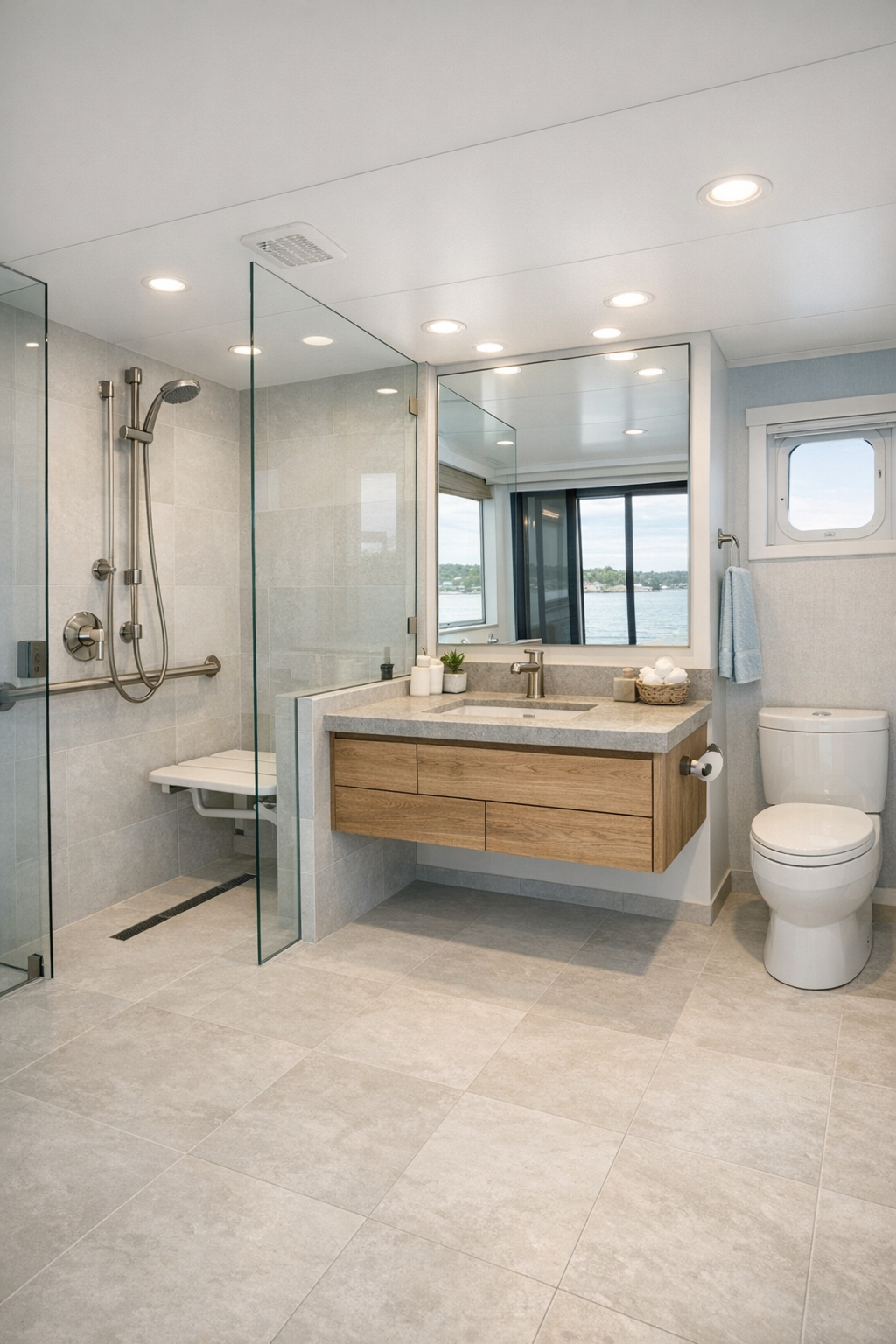
The bathroom is one of the strongest examples of how this houseboat merges practicality with beauty. Rather than hiding accessible features, the design folds them into a spa-like composition of large-format tile, warm wood, and clean-lined fittings. A curbless shower is the obvious centerpiece, likely enclosed with a frameless glass panel to keep sightlines open. I can see a floating vanity in white oak or a painted satin finish, topped with a pale stone counter and paired with a large mirror that helps bounce light around the room.
Details matter enormously in a bathroom like this, and here they seem thoughtfully handled. Slip-resistant flooring, a shower bench, integrated grab support, and handheld as well as fixed shower fittings all contribute to ease without disrupting the calm aesthetic. The palette is probably the coolest in the home—soft gray, ivory, brushed nickel, and watery blue undertones—which suits the setting beautifully. It feels clean, restorative, and intelligently planned, the sort of bathroom where function has been edited into elegance.
Other Areas
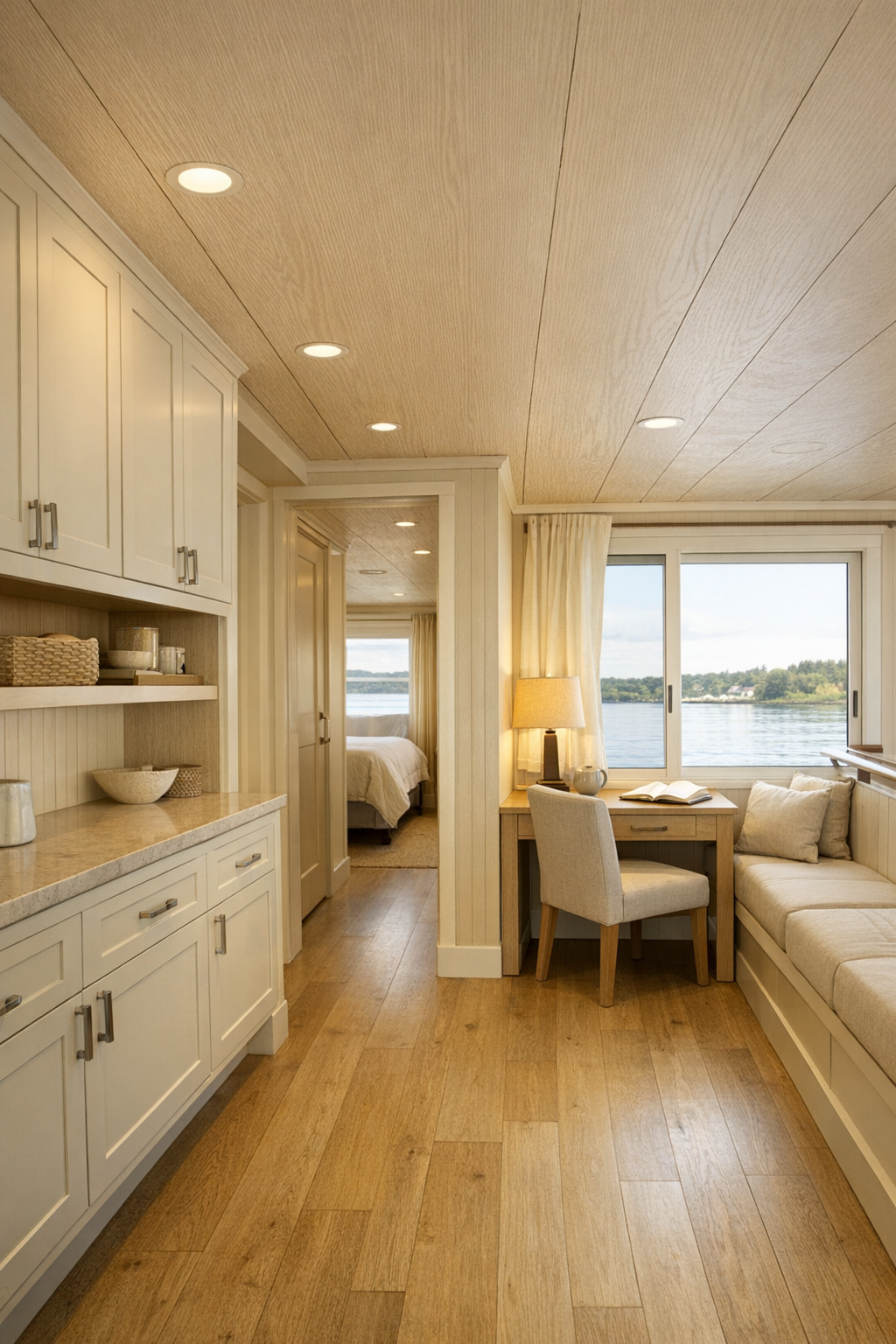
What elevates this houseboat beyond its main rooms are the transitional spaces, which are often overlooked in small homes but are especially important in barrier-free design. Hallways are wide enough to feel like part of the living environment rather than leftover circulation, and built-in storage likely lines at least one wall in a clean run of cabinetry. I can also imagine a compact office nook or reading corner with a built-in desk, open shelving, and a comfortable chair positioned near a window. On a houseboat, every inch has to earn its keep, and here those supporting spaces appear to do so with real polish.
The outdoor deck areas deserve mention too, even if they function almost like additional rooms. With flush transitions, sturdy seating, and enough space for container plantings or a small café table, they extend the home’s livability in a very natural way. I would not be surprised to find a bench with hidden storage, durable marine-grade textiles, and low lighting for evening use. These are the areas that make daily life smoother—places to pause, store, work, or simply watch the light change on the water—and they help the entire home feel complete.
Why You'd Live Here
You would live here because it offers something still surprisingly rare: a home designed for ease that also feels genuinely beautiful. Too often, accessible design is treated as purely technical, but this houseboat understands that comfort is emotional as well as physical. The proportions are generous, the finishes are calm and tactile, and the relationship to the water gives even ordinary moments a slower, steadier rhythm. That combination would be enough to win me over.
I also think there is something deeply appealing about the honesty of this home. It does not rely on excess square footage or flashy gestures. Instead, it focuses on thoughtful planning, durable materials, and rooms that support the way people really live, cook, gather, and rest. For anyone who wants classic charm without obstacles—literal or visual—this barrier-free houseboat makes a very convincing case.