
There is something deeply heartening about a home that knows exactly what it wants to be, and this converted bus, tucked into a green summer homestead, has that kind of quiet confidence. From the outside, it carries a bit of old-road romance, but step closer and the whole place softens into a thoughtful blend of cottage comfort, off-grid practicality, and hand-tended beauty. It sits in the landscape the way a good pie cools on a farmhouse sill—simple, humble, and somehow irresistible.
What makes this little dwelling so special is the way it turns restraint into richness, making every inch count without ever feeling pinched or fussy. Though it is a concept design, it feels entirely lived-in in spirit, with sun-washed wood, hardworking built-ins, soft textiles, and clever storage folded into a layout that feels both efficient and surprisingly gracious. I find that especially lovely, because the best homes do not always need more space; they simply need more care.
Exterior

The bus keeps much of its recognizable silhouette, and that is part of its charm, but it has been transformed with a gentler, more domestic character. The body is painted in a warm cream with muted sage trim, and the windows are framed neatly enough to feel almost cottage-like against the long, curved form. A simple wood awning shades the entry, and beneath it, a small landing of weathered planks leads to the door, as though inviting muddy boots, baskets of herbs, and one more slow evening outdoors. Planter boxes, galvanized tubs, and a few climbing vines soften the edges further, helping the bus settle naturally into the homestead around it.
What I especially like is how the off-grid features are handled without making the place feel technical or severe. Solar panels are integrated cleanly on the roofline, a rain barrel system is tucked alongside a trellis, and a compact deck extends the living space into the summer air. Gravel paths, native grasses, and a kitchen garden lend the whole setting a grounded, self-sufficient feeling. Nothing looks showy; it looks useful, loved, and enduring, which to my eye is the prettiest kind of design there is.
Living Room
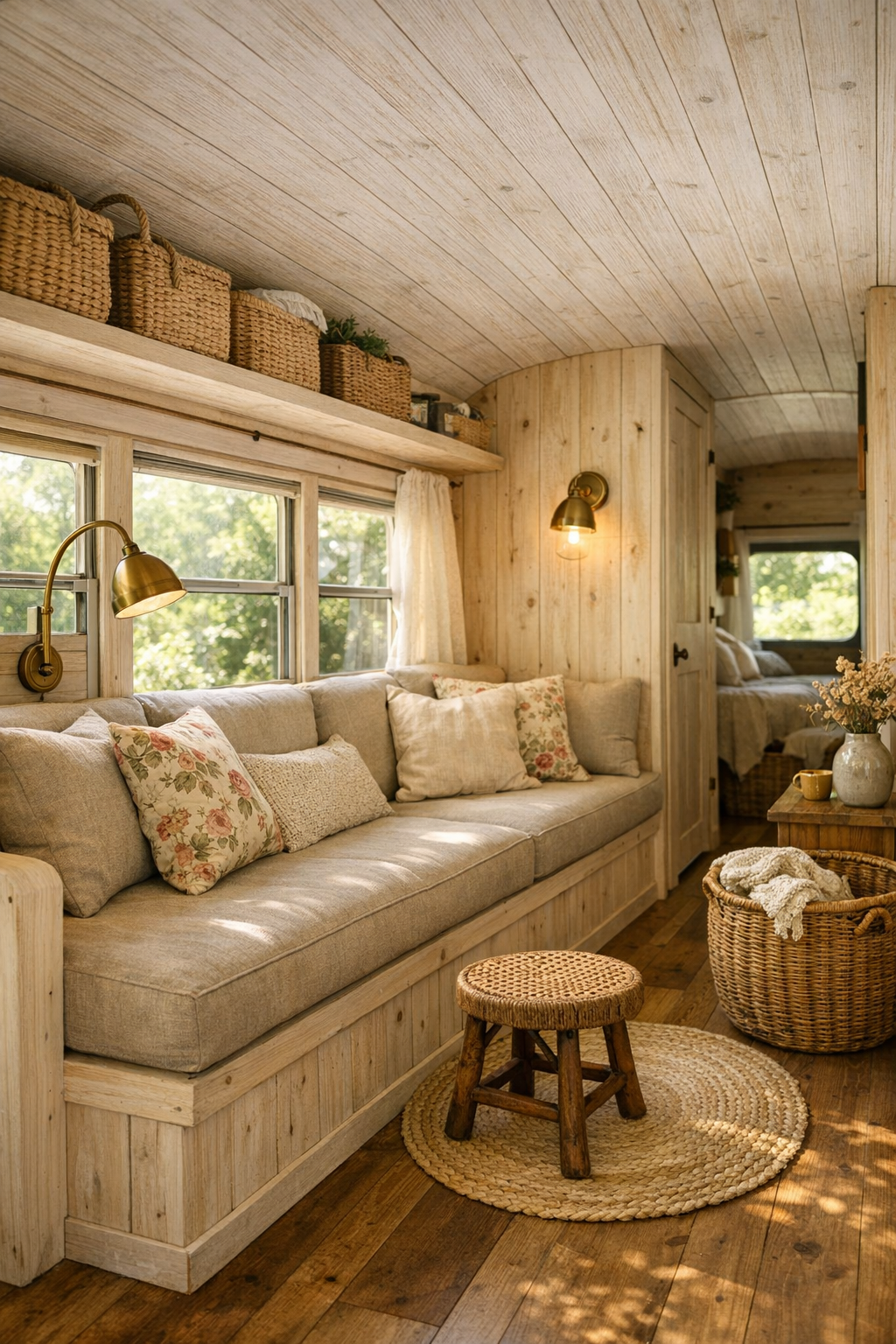
The living room occupies the brightest central stretch of the bus, and it is arranged with remarkable tenderness toward both light and movement. A built-in bench sofa runs beneath the windows, topped with flax-colored cushions, faded floral pillows, and a wool throw in soft oat and rust tones. Across from it, slim shelving and low cabinetry make use of the bus’s narrow proportions without crowding them, while pale pine walls and a whitewashed ceiling reflect daylight from every side. The overall palette feels drawn from the homestead itself: buttercream, sage, weathered wood, and the quiet blue-gray of distant shade.
Because the room is long rather than wide, the furnishings are scaled carefully and kept close to the perimeter, leaving a clear path through the middle. A small round stool doubles as a side table, an antique brass reading lamp adds a touch of glow in the evening, and woven baskets below the bench bring in practical storage with texture to spare. I can imagine this being the kind of room where coffee is poured before the heat of the day sets in, or where the windows are cracked open at dusk and the whole place fills with the smell of cut grass.
Dining Room
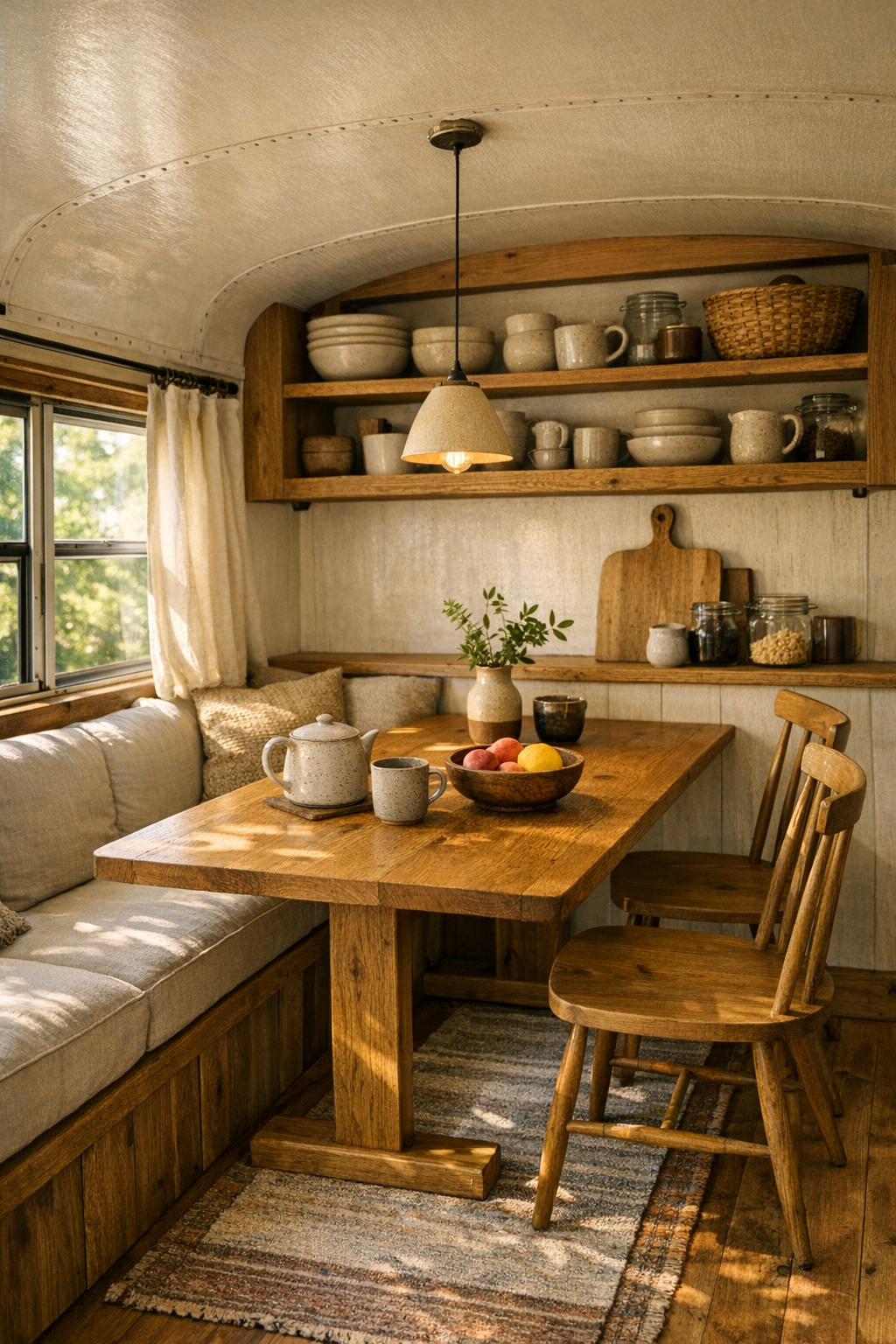
The dining area is wonderfully compact, yet it has all the dignity of a proper place to gather. A small built-in table in natural oak sits beside the windows, paired with a bench on one side and a pair of spindle-back chairs on the other, so the arrangement feels balanced rather than cramped. The grain of the wood adds warmth, and a narrow runner in muted brick and cream introduces just enough pattern to keep the space from feeling too spare. Overhead, a modest shaded pendant casts a golden pool of light that would make even a simple supper feel intentional.
I appreciate how this little corner leans into ritual. There is open shelving nearby for stacked stoneware, enamel mugs, and a crock of wooden spoons, and the whole composition feels like an old farmhouse dining room thoughtfully distilled to its essentials. The windows do much of the decorating, of course, framing the garden and meadow beyond, but there is likely a jar of Queen Anne’s lace or field daisies set at center most days. It is the sort of place that reminds me how a meal need not be grand to feel memorable.
Kitchen
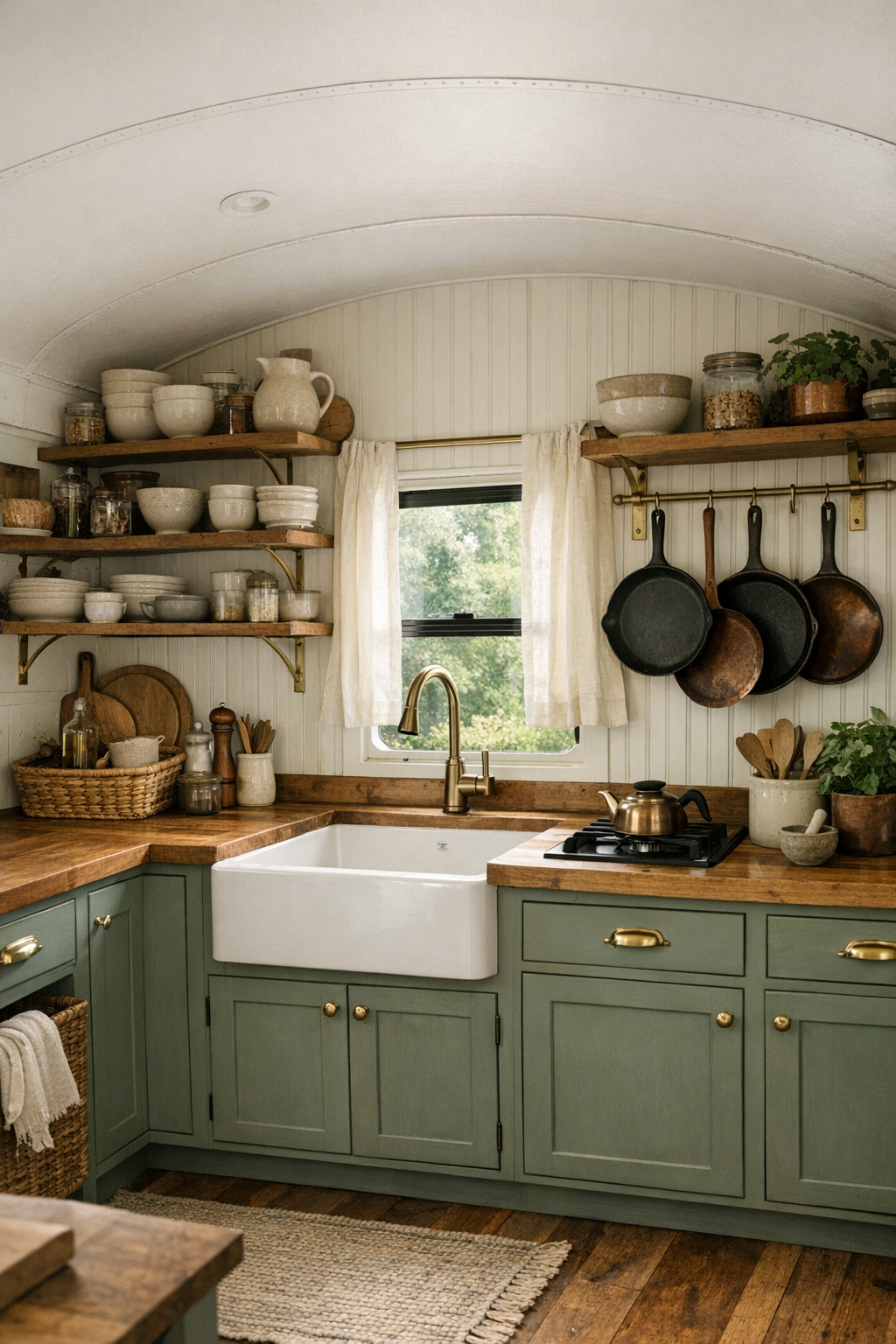
The kitchen is, to my mind, the heart of this bus, and it has been designed by someone who understands that even a small cooking space must be sturdy, sensible, and pleasant to work in. Cabinetry is painted a dusty sage, grounded by butcher-block counters that bring in the look of a well-used worktable. A white apron-front sink sits under a window, and that placement alone gives the room such welcome cheer. Open shelves hold everyday dishes, glass jars of grains and beans, and neatly folded linens, while a compact range and under-counter refrigerator are integrated so gracefully that nothing interrupts the room’s homely calm.
There is also a smart off-grid practicality here that never sacrifices beauty. A rail for hanging pans, peg hooks for towels and utensils, and deep drawers below keep clutter managed, while beadboard backsplashes and aged brass hardware add a familiar, timeless note. The lighting is layered in a thoughtful way too: natural daylight for prep, small sconces for evening warmth, and under-shelf illumination to brighten the counters. I have spent enough years in kitchens to know that a room like this would earn your trust quickly; it looks ready for biscuits, tomatoes, soup stock, and all the ordinary miracles of daily cooking.
Bedroom
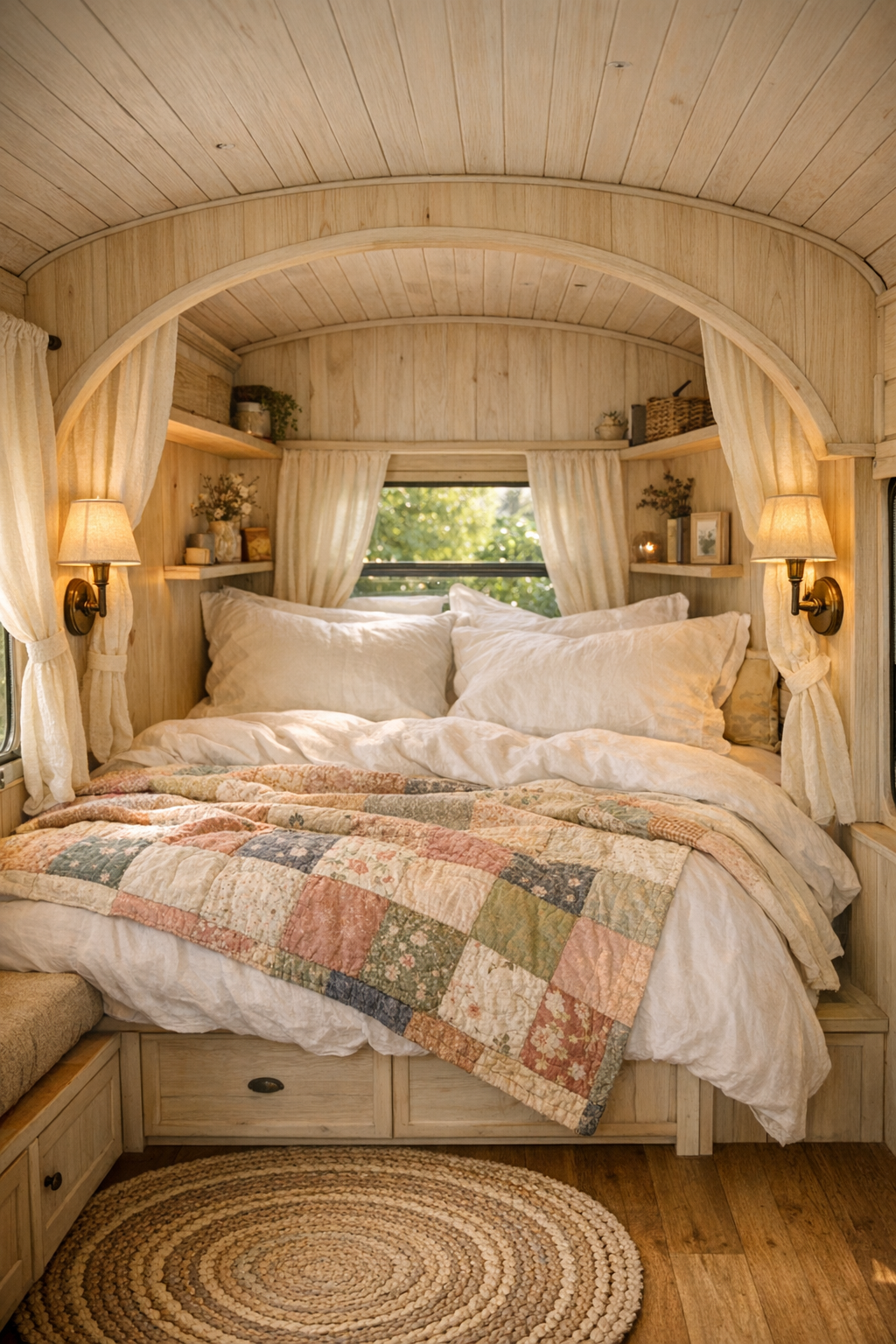
The bedroom, set toward the quieter end of the bus, feels calm in the way a screened porch feels calm after supper. The bed is tucked into a built-in alcove, dressed in soft white linen with a quilt in faded patchwork colors that gives the space immediate tenderness. Wall-mounted sconces free up precious surface area, while shallow shelves above the headboard hold books, a small pottery vase, and perhaps one treasured photograph. The palette turns a little gentler here—cream, washed flax, dusty blue, and sun-faded rose—so the room reads as restful from the moment you step in.
What makes it especially successful is the careful use of vertical space and hidden storage. Drawers are built beneath the bed platform, overhead cabinets follow the bus’s curve without feeling heavy, and a narrow wardrobe is fitted flush into the wall. Lightweight curtains soften the windows and provide privacy without blocking the light, and a braided rug underfoot adds just enough coziness to keep the room from feeling too tailored. It is a small sleeping space, certainly, but it holds the kind of quiet order that helps a person truly exhale.
Bathroom
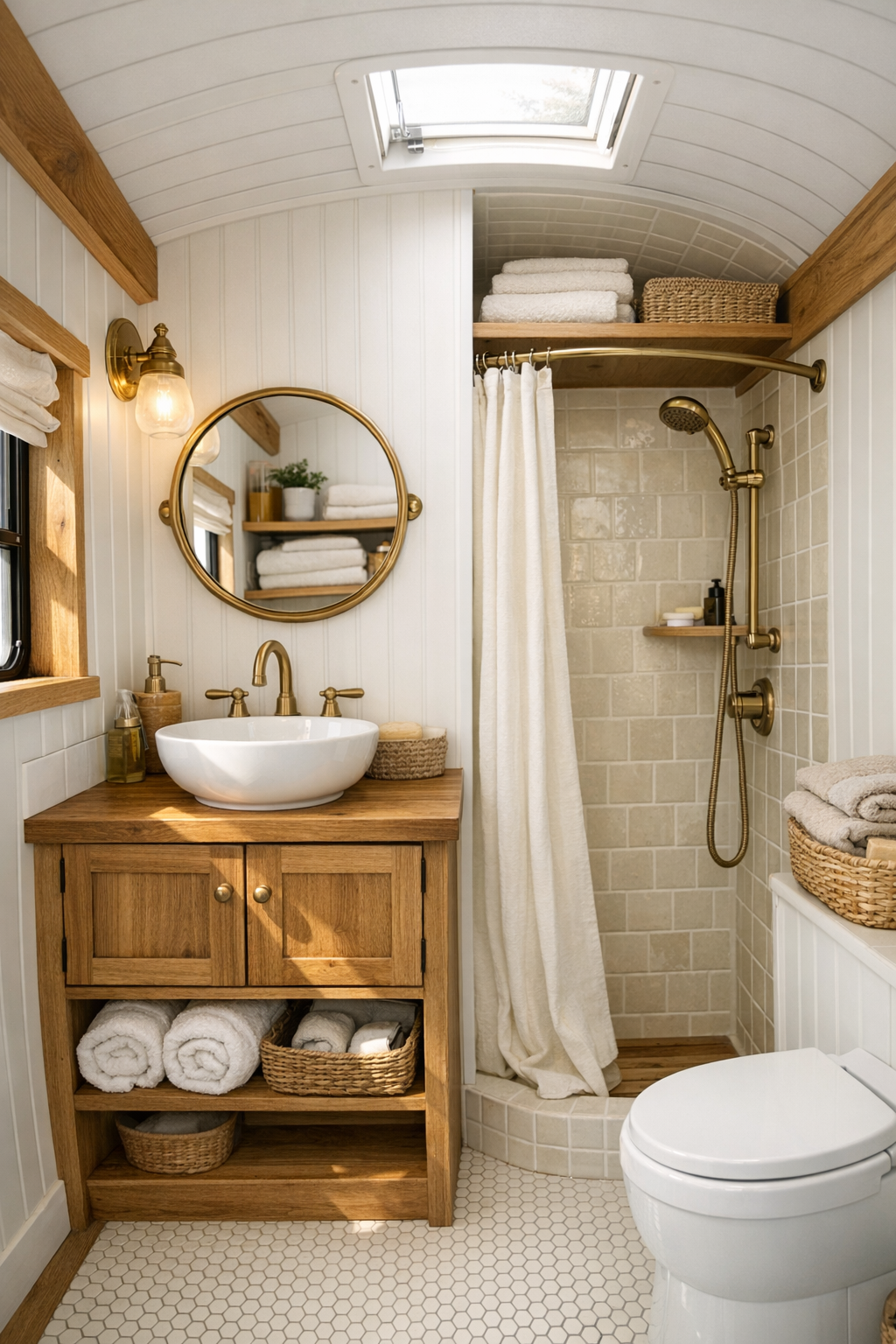
The bathroom is one of the cleverest spaces in the whole home, because it manages to feel fresh and orderly rather than merely compact. The walls are clad in narrow vertical paneling painted a soft warm white, which helps elongate the room, while the floor is finished in small muted tile that feels both durable and charming. A petite vanity in natural wood supports a simple basin sink, topped by a framed mirror that reflects light back through the room. Brass fixtures and a few black accents give the space definition without making it feel too modern or hard-edged.
In the shower, I imagine glossy cream tile catching the light beautifully, with a small niche for soap and a linen curtain that can be drawn back to keep the room feeling open. Open cubbies for towels, a hook rail for robes, and a tiny ledge for daily necessities make everything practical and easy to reach. There is a simplicity here that reminds me of old summer cabins—clean lines, honest materials, and no waste of space—yet it is softened by texture and warmth so it never feels austere.
Other Areas
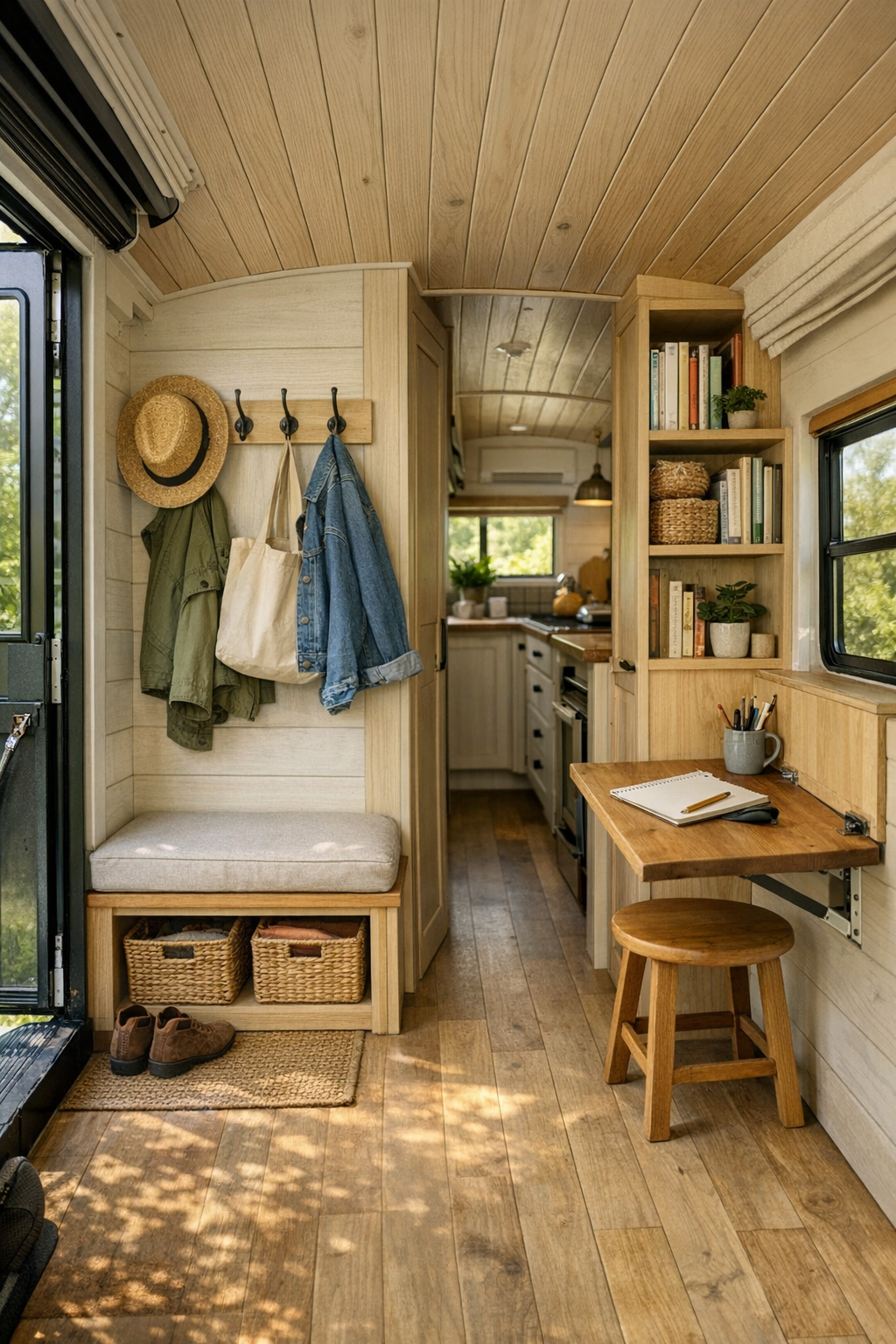
Beyond the main rooms, this home makes beautiful use of every in-between inch. The entry is fitted with hooks, a narrow boot tray, and a lift-top bench for garden tools or blankets, making the threshold feel useful from the first step in. Hallway walls do double duty with slim cabinetry, bookshelf niches, and fold-down surfaces that can serve as a desk or extra prep space. Even the ceiling line is considered, with warm wood ribs and concealed storage tucked so neatly into the curve that the architecture itself becomes part of the furnishing.
Outside the main bus body, the adjacent deck and shaded sitting area function almost like an extra room through the summer months. A pair of simple wooden chairs, a small table, string lights, and herb pots extend daily life outdoors, while a nearby utility nook discreetly houses batteries, water systems, and other off-grid essentials. I am always fond of homes that understand living is not confined to formal rooms, and this one seems to honor that truth at every turn, offering corners for reading, working, storing, and simply being still.
Why You'd Live Here
You would live here if you believe comfort comes more from intention than from square footage. This bus has been imagined with such care that it offers not just shelter, but rhythm: a place to wake with the sun, cook close to the garden, open the windows to the breeze, and move through the day with a little more attention. Its beauty is not extravagant. It is steady, useful, and deeply calming.
For me, that is the lasting appeal. This home takes the old American instinct to make do, then wraps it in grace and good design until it feels less like compromise and more like wisdom. In a world forever urging us toward bigger, faster, and louder, there is something mighty persuasive about a small off-grid home that says, ever so kindly, that enough can be more than enough.