
This converted bus has the kind of quiet confidence I always notice in the best small-space design: nothing flashy, nothing forced, just a deeply considered interior wrapped in a rugged countryside shell. Set against open fields and low grasses, the home balances utility and warmth with a style that feels part Scandinavian cabin, part modern farmhouse, and part traveling retreat. Even as a concept design, it feels remarkably livable, with every inch working hard without ever seeming cramped.
What makes it special to me is the way the layout creates rhythm. There is a clear visual flow from one zone to the next, but each space still has its own mood, defined through texture, built-ins, and subtle shifts in light. I’m especially drawn to the honest material palette here—painted paneling, warm timber, matte black hardware, linen, leather, and softly worn finishes—which gives the bus a grounded, settled feeling rather than a temporary one.
Exterior

From the outside, the bus keeps enough of its original character to remain charmingly recognizable, but it has been refined into something far more architectural. The body is finished in a muted, weather-friendly tone—something between creamy oat and soft sage—that sits beautifully in a rural setting. Black-framed windows punch through the façade with crisp contrast, while a simple roof rack fitted with solar panels quietly signals the off-grid practicality at work. I like that the design does not try to disguise the bus completely; instead, it celebrates the silhouette and updates it with restraint.
The entry is what really softens the vehicle into a home. A compact timber landing, perhaps with a few potted herbs and a lantern or two, turns the door into a welcoming threshold rather than a utilitarian access point. The exterior styling suggests durability, but not harshness: natural wood, sturdy metal, and understated lighting make it feel capable and calm. In a countryside setting, that combination is exactly right, because the home looks prepared for weather, quiet evenings, and a slower daily pace.
Living Room
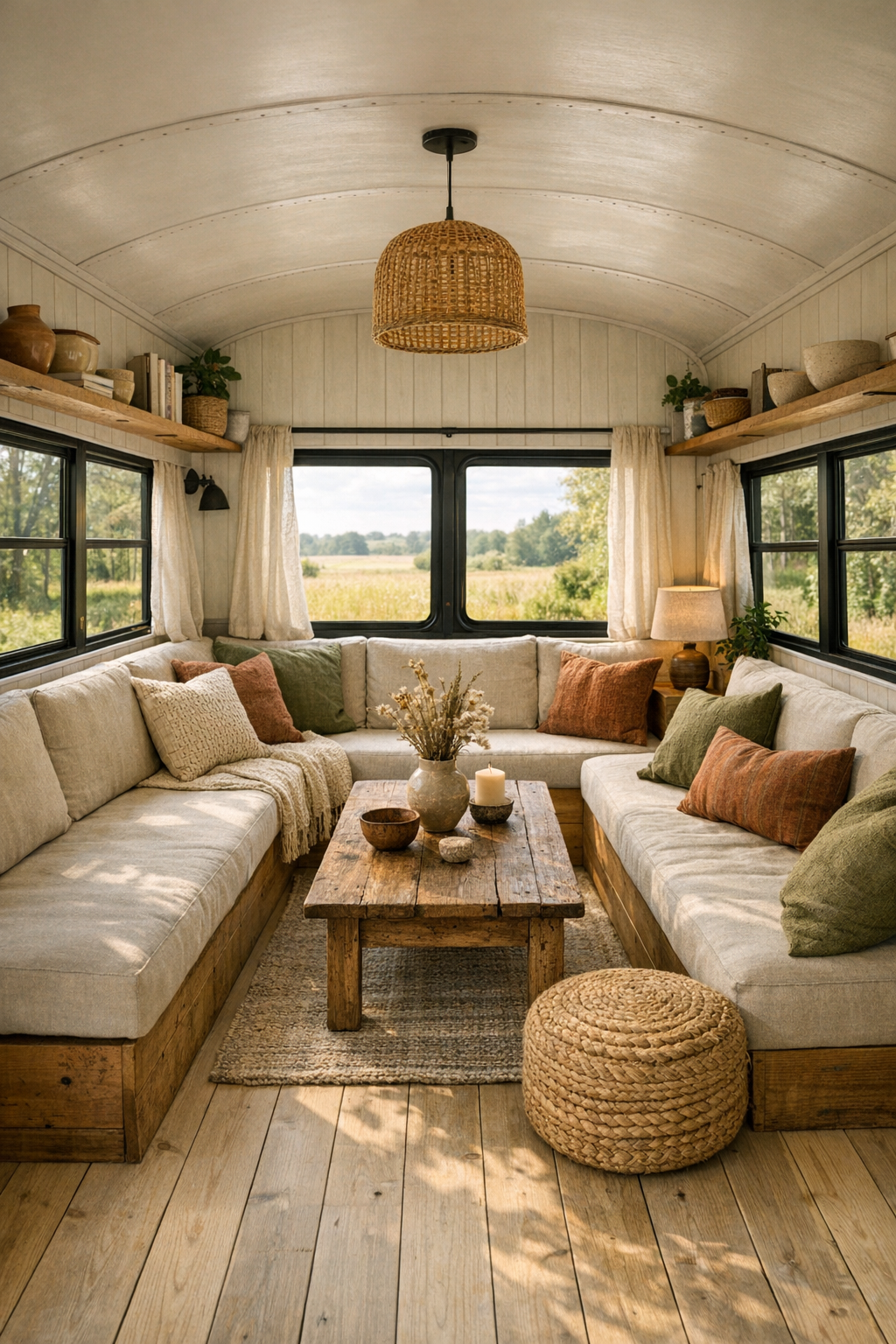
The living room is a masterclass in making a narrow footprint feel expansive. One side features a built-in bench sofa layered with oatmeal linen cushions, a camel-toned throw, and a mix of textured pillows in clay, moss, and charcoal. Across from it, slim cabinetry and open shelving keep the sightlines clear, allowing the windows to do their work. I can easily imagine morning light washing over the pale wood floorboards and painted walls, making the whole space glow rather than merely brighten.
What I appreciate most is the furniture discipline. There is no bulky coffee table interrupting movement; instead, perhaps a pair of small nesting stools or a narrow timber ledge offers flexibility. Wall sconces with warm brass or matte black finishes provide evening light without taking up precious room, and a compact wood stove or minimalist electric heater could anchor the far end beautifully. The result is a living space that feels equal parts reading nook, conversation area, and lookout point to the landscape beyond.
Dining Room
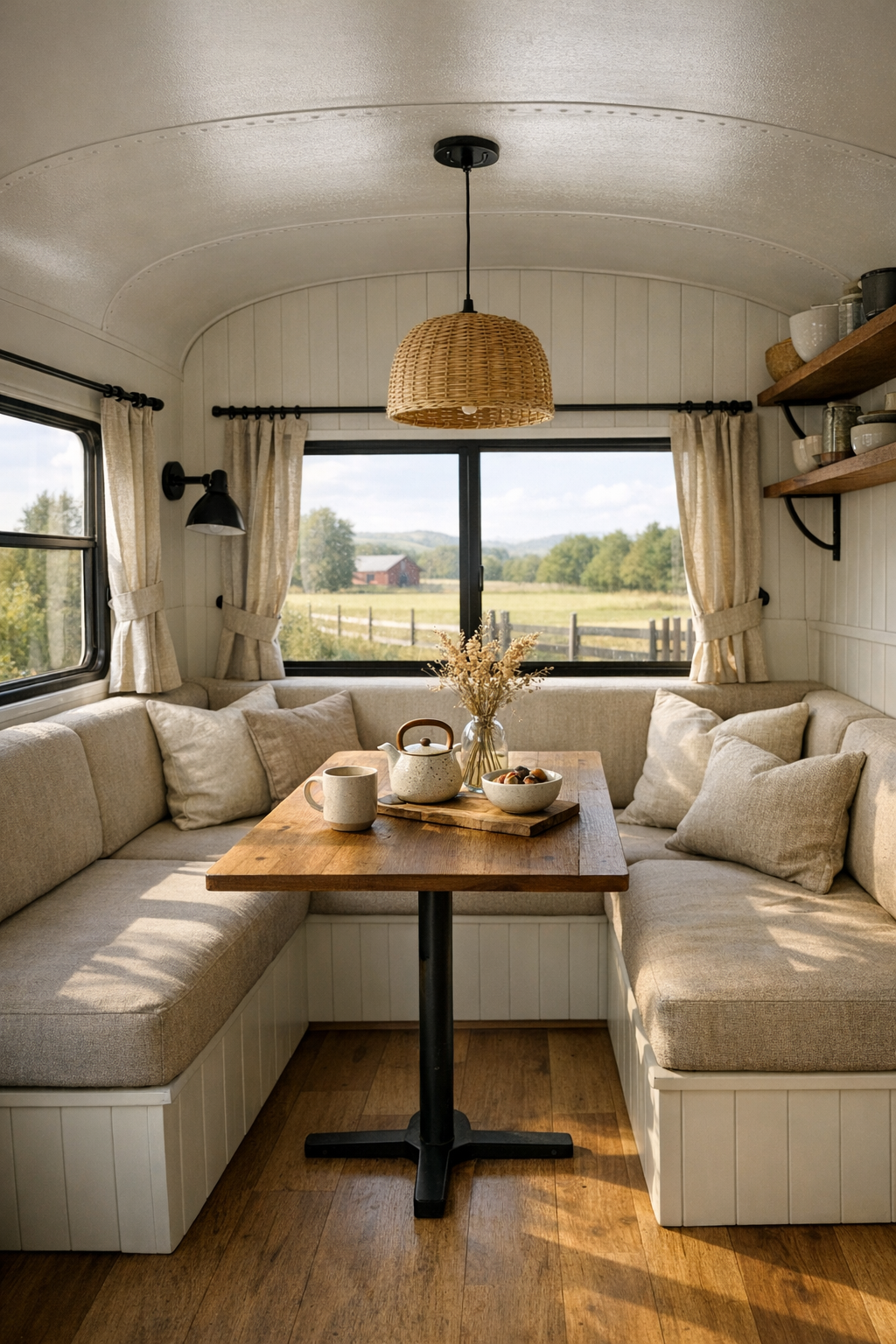
In a home like this, the dining area has to earn its place, and here it absolutely does. A compact built-in banquette paired with a slim rectangular table makes the most of the bus’s linear shape, creating a dining nook that feels tucked in rather than squeezed in. I love the idea of seat cushions in muted flax or soft olive, with a solid wood tabletop that brings a bit of visual weight and permanence. The windows become part of the experience, too, turning every meal into something just a little more scenic.
Because I spend so much time thinking about how people gather around food, this area feels especially successful. The lighting might be a small pendant with a hand-thrown ceramic shade or a neat articulated wall light, scaled carefully so it adds personality without clutter. Under-seat storage would be essential, of course, but hidden neatly enough to preserve the room’s calm. It is a small dining space, yet it has the intimacy of a favorite breakfast corner and the practicality needed for real, everyday cooking and eating.
Kitchen
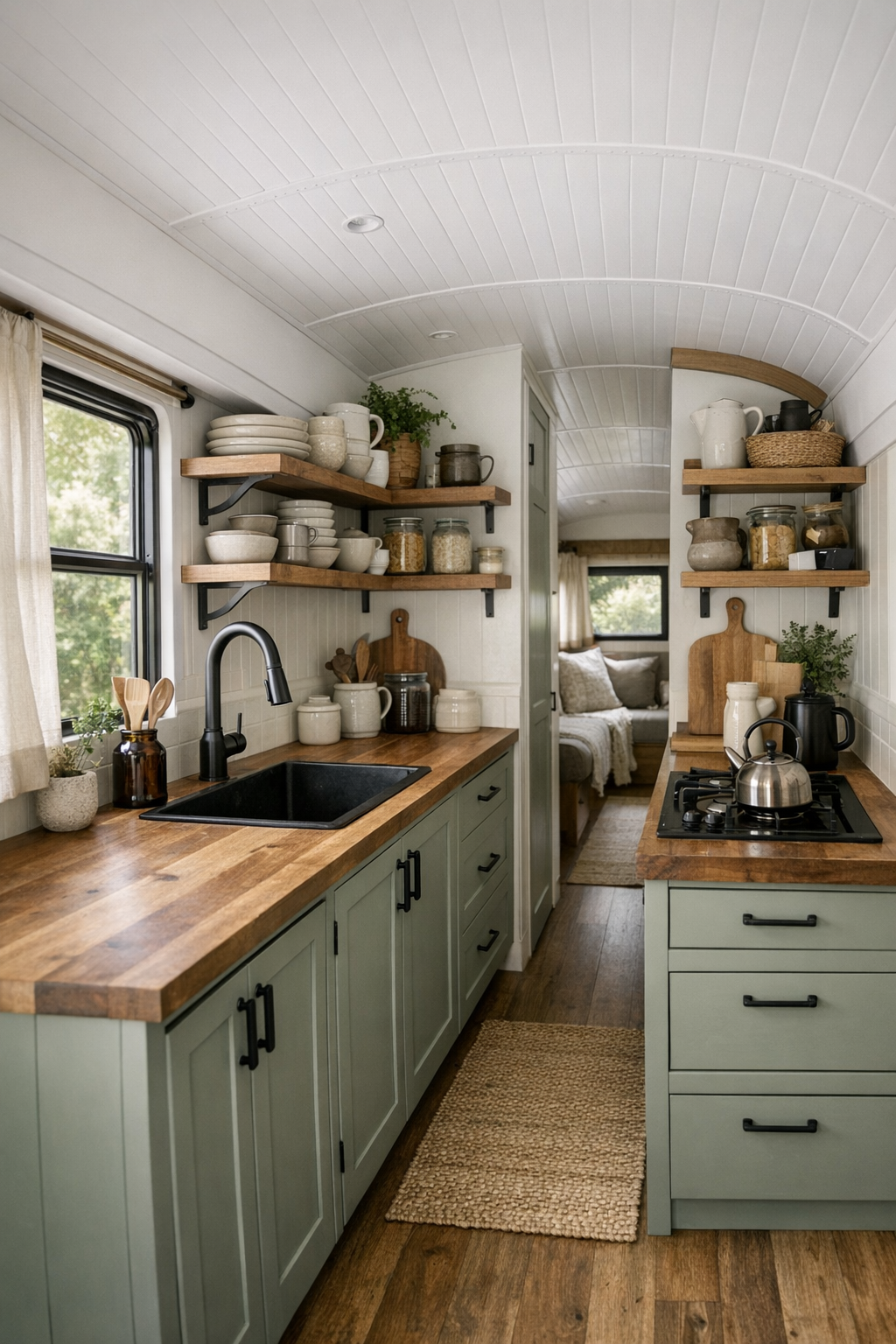
The kitchen is where this home becomes especially persuasive to me, because it understands that a small kitchen still deserves to be a serious one. The cabinetry is likely flat-front and custom-fitted, painted in a soft muted tone such as sage, mushroom, or warm white, with simple pulls in aged brass or matte black. Butcher block or lightly honed stone counters would add tactile richness without overwhelming the scale. Open shelves for ceramics, spice jars, and a few well-used cooking essentials keep the kitchen feeling personal and highly functional.
What makes the layout breathtaking, frankly, is the way the galley proportions are turned into an advantage. Everything is within easy reach: a compact cooktop, an undercounter fridge, a deep sink, and smart vertical storage for pantry goods and cookware. As someone who cooks often, I can see how well this would support real meal prep, especially with thoughtful details like knife strips, rail storage, and a narrow prep surface kept mostly clear. Under-cabinet lighting would sharpen the work zones, while a small window over the sink would make even cleanup feel connected to the landscape.
Bedroom
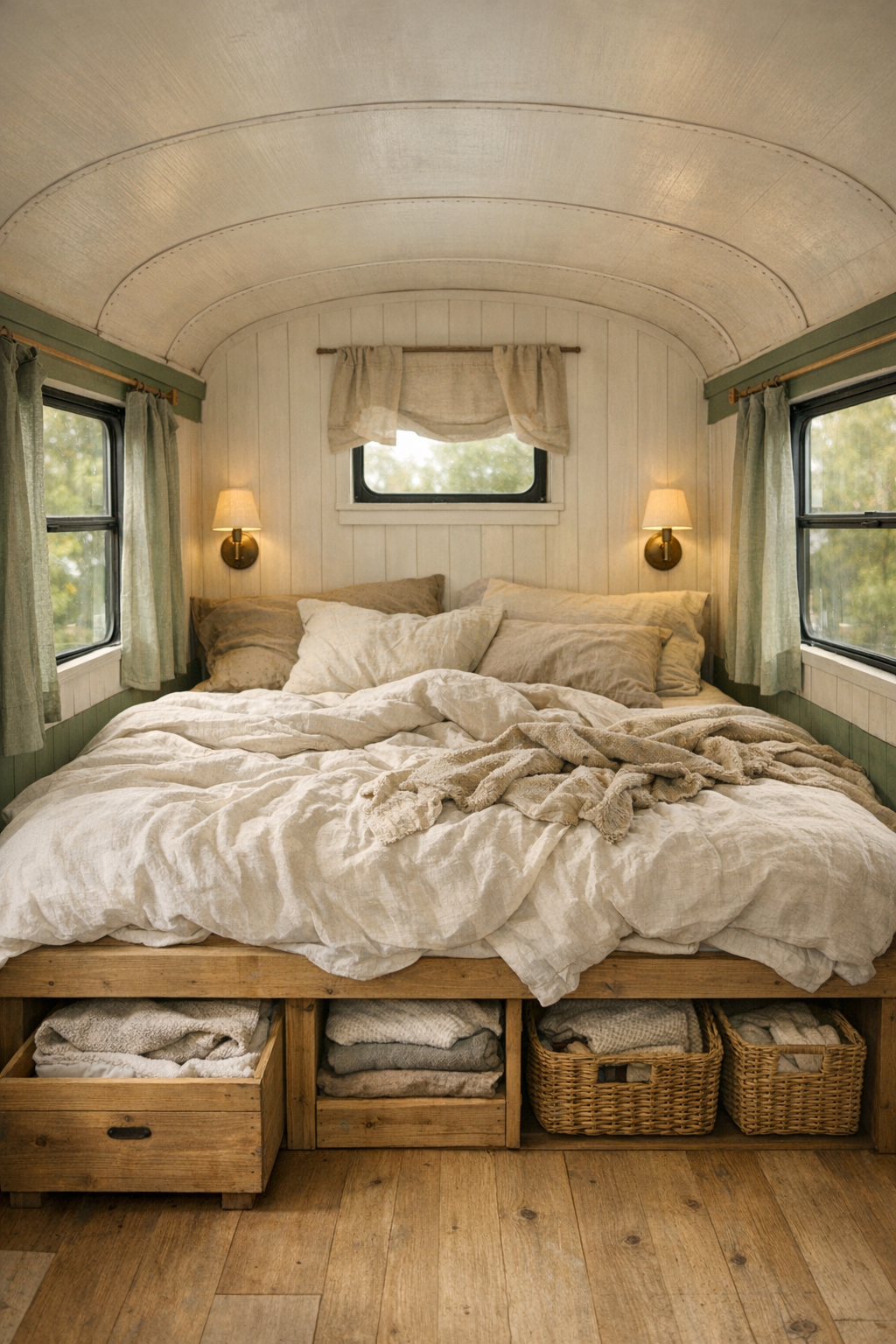
The bedroom trades square footage for serenity, and I think that is exactly the right decision. Positioned at one end of the bus, it feels cocooned without becoming dark, thanks to strategically placed windows and a restrained palette of soft ivory, sand, weathered wood, and dusty green. The bed platform likely includes drawers below, but visually it reads as simple and calm, dressed in rumpled linen bedding and a wool blanket that adds just enough weight and texture.
There is something deeply appealing about how little this room asks of you. A narrow ledge in place of nightstands, a pair of petite sconces, maybe a curtain or slatted divider for a hint of privacy—every choice seems to favor ease. The ceiling line, often a challenge in converted vehicles, becomes an asset when highlighted with paneling or timber trim that draws the eye lengthwise. It is a room designed for early nights, open windows, and the kind of sleep that comes easily in the countryside.
Bathroom
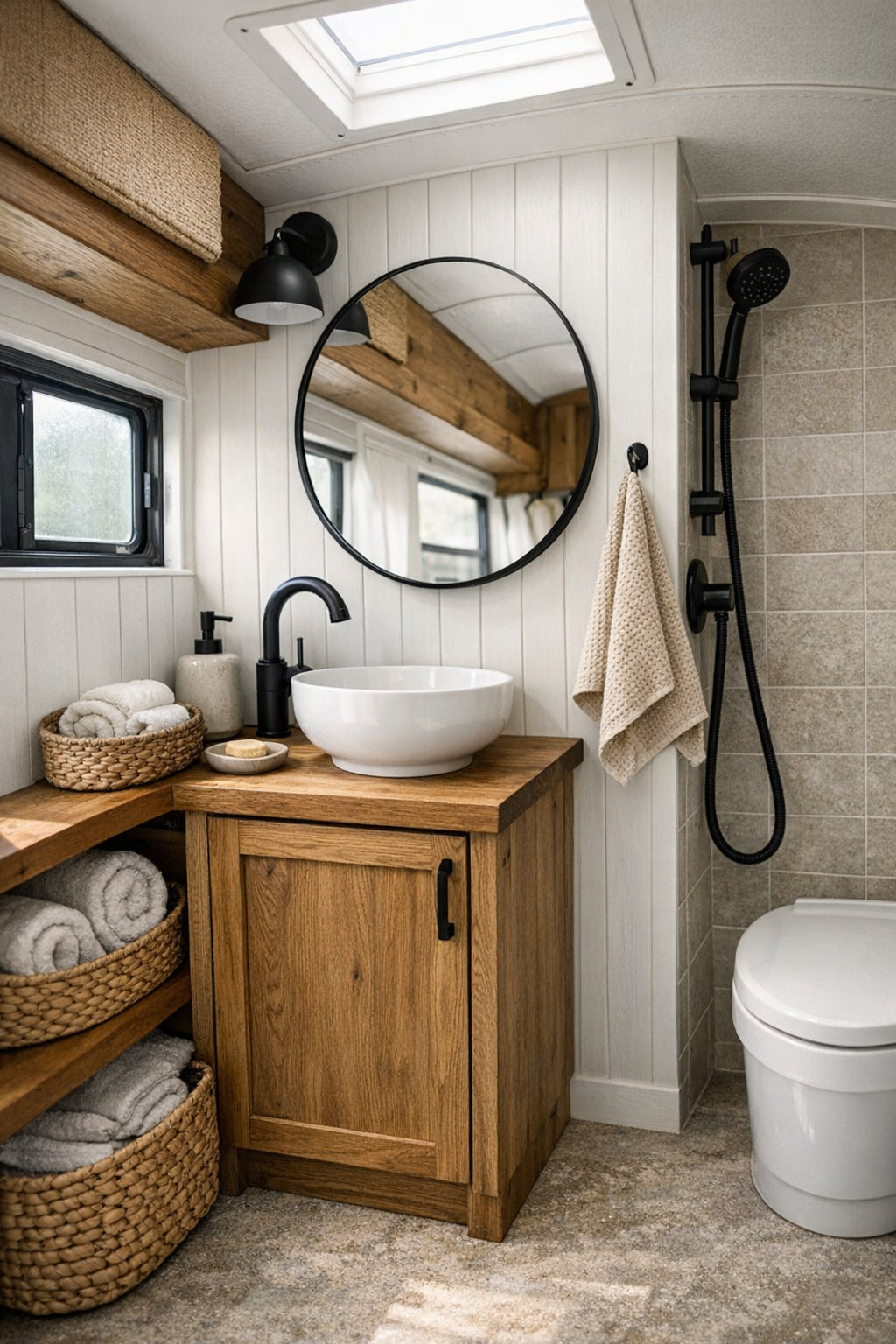
The bathroom is compact, but it does not feel apologetic about its size. Instead, it leans into clean lines and tactile finishes: perhaps microcement or small-format tile underfoot, vertical paneling or tile on the walls, and a petite vanity in stained oak or painted wood. A rounded mirror would soften the tighter geometry nicely, while black fixtures keep the room visually crisp. In a space this small, every finish matters, and here the materials seem chosen to make the room feel fresh, durable, and quietly elevated.
I also admire the likely emphasis on light and order. A small window, a skylight, or both could make a dramatic difference, giving the room an airy quality that is often missing in tiny bathrooms. Woven baskets, recessed shelving, and neatly integrated towel hooks would keep the essentials close without adding clutter. It is the kind of bathroom that feels efficient in the best sense—easy to clean, pleasant to use, and surprisingly spa-like for something tucked inside a bus.
Other Areas
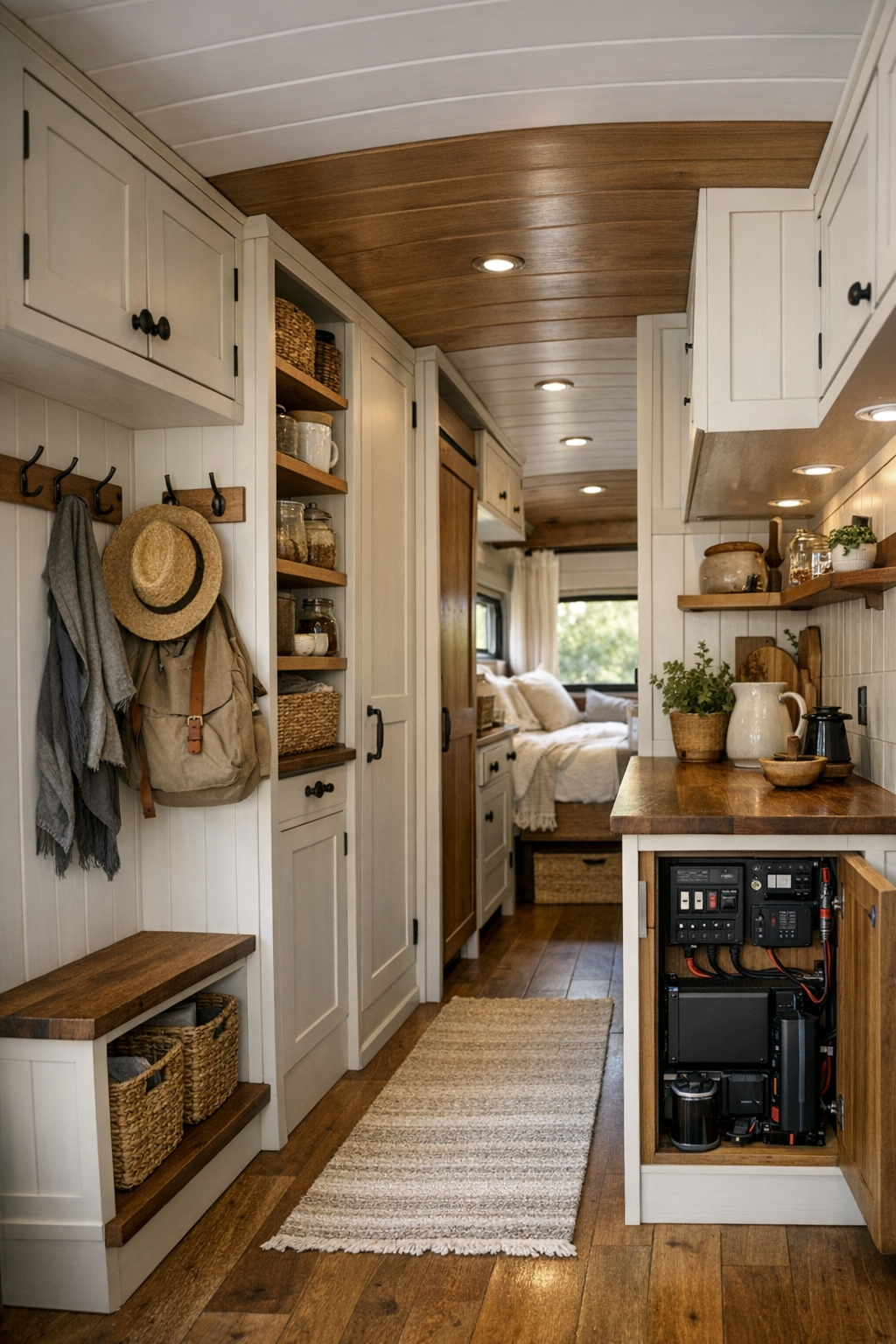
The transitional spaces are where this design shows real intelligence. In a bus conversion, hallways, thresholds, and leftover slivers of wall cannot be wasted, and here they are transformed into purposeful storage, display, and utility zones. I can picture overhead cabinets finished to match the wall paneling so they recede visually, along with narrow cubbies for books, pantry overflow, boots, and daily essentials. Even a fold-down desk or small work perch could be integrated without disturbing the overall calm.
These supporting areas also help the home feel tailored rather than improvised. Hooks by the door, concealed charging spots, under-bench compartments, and tidy mechanical storage for off-grid systems all contribute to that sense of order. What I find most satisfying is that the practical features do not interrupt the atmosphere; they reinforce it. The bus feels beautifully edited from end to end, with every in-between moment treated as part of the design rather than an afterthought.
Why You'd Live Here
You would live here if you value design that solves problems beautifully. This home proves that off-grid living does not have to feel makeshift or austere; it can be warm, deliberate, and genuinely comfortable. The layout is breathtaking not because it is extravagant, but because it makes such skillful use of proportion, light, and material that the entire interior feels larger and calmer than its footprint should allow.
I also think you would live here for the lifestyle it suggests: slower mornings, simpler upkeep, better attention to what you actually use, and a stronger connection to the landscape outside your windows. For someone like me, who sees a home partly through the rituals it supports—coffee brewing, dinner simmering, a quiet seat by the window—this converted bus feels especially compelling. It is compact, yes, but it never feels lesser; it feels distilled.